
What a DeSoto County Court Docket Shows
A docket is a dated index of everything filed and decided in a case. Each line is a docket entry. It records the date, the document or event, and a short description of what took place. The docket grows as the case moves, so it reads as a timeline. A reader can scan it to see when a complaint was filed, when motions were argued, when a hearing was held, and when a judgment was entered. The docket points to the paperwork, but it is not the paperwork itself.
The full case file holds the actual documents. Pleadings, exhibits, signed orders, and transcripts live there. The docket is the shorter map that lists those items in order. Because it is compact and easy to read, the docket is the fastest way to confirm case status and the next court date. People use it to follow criminal cases, civil suits, divorce matters, and traffic citations across DeSoto County courts.
One word causes confusion. In DeSoto County the term "docket" appears in two very different places. A court docket lists case events and hearings. The county jail docket is a booking list of people held at the Adult Detention Facility, not a schedule of court hearings. The jail docket answers who is in custody right now. The court docket answers what is happening in a case and when.
Where DeSoto County Dockets Are Posted
No single portal covers every court level in the county. The path depends on which court holds the case. Circuit, County, and Chancery dockets are reached through Mississippi Electronic Courts, the statewide case system. Justice Court and city municipal courts often keep their own records and are contacted directly. The DeSoto County courts page lists each court and links to its office.
Online access runs through Mississippi Electronic Courts, known as MEC and its public side PAMEC. Public access requires registration and a login before many case dockets, party names, and document images can be viewed. Some images stay gated or are blocked for confidential filings. When a record is missing, sealed, paper only, or recently filed, the clerk counter at the courthouse remains the fallback. The county directory lists current phone numbers for each office.
Access channels for a DeSoto County docket include the following routes.
- Online through MEC or PAMEC, with a registered login, for participating Circuit, County, and Chancery cases.
- In person at the Circuit Clerk or Chancery Clerk counter inside the courthouse in Hernando.
- By phone to the correct court or clerk using the county directory.
- Direct contact with the Justice Court clerk for county misdemeanor, small claim, and traffic matters.
- Direct contact with a city municipal court clerk for citations issued inside city limits.
DeSoto County Circuit Court Dockets
Circuit Court is the main trial court for felonies, major civil suits, and appeals from lower courts. Its dockets track the heaviest criminal and civil matters in the county. Entries follow a case from indictment or complaint through motions, hearings, trial, and final judgment. DeSoto County sits in the 17th Circuit Court District, and Circuit Court cases are filed with the Circuit Clerk.
The official DeSoto County Circuit Court page describes the court and its role.
A Circuit Court docket entry may show charge descriptions, plea dates, trial settings, and sentencing orders for criminal cases. Civil dockets list the cause of action, service returns, motions, and the final judgment. The full criminal case file, including charges and sentence detail, is covered on the DeSoto County criminal court records page. The docket is the timeline; the case file is the evidence behind it.
DeSoto County Chancery Court Dockets
Chancery Court handles equity and family matters. Divorce, custody, child support, guardianship, conservatorship, estates, wills, and land disputes all move through this court. Its dockets read differently from criminal dockets because the parties are usually a petitioner and a respondent rather than the State and a defendant. Chancery cases are filed with the Chancery Clerk, a separate elected office from the Circuit Clerk.
The DeSoto County Chancery Court page outlines the court terms and the matters it hears.
Chancery dockets list petitions, temporary orders, hearing notices, and final decrees. Some entries point to sensitive material. Children's information, financial accounts, and sealed exhibits can be redacted or withheld. The Chancery Clerk also runs land and recorded-document searches through the Delta Computer Systems portal, which is built for instruments and indexes rather than full case dockets.
DeSoto County County Court Dockets
County Court sits between Circuit Court and the lower courts. The county courts page describes a Civil Division, a Criminal Division, and a Youth Court Division. County Court carries a civil jurisdiction limit up to $200,000 and can hear non-capital felony cases transferred from Circuit Court. County Court judges may issue search warrants, set bond, and hold preliminary hearings. These records route through the Circuit Clerk.
The DeSoto County County Court page sets out this jurisdiction in more detail.
Youth Court entries are the exception. Juvenile matters are confidential, so a County Court docket does not expose youth case details to the general public. Civil and adult criminal entries in County Court are tracked much like Circuit Court entries, with filing dates, hearing settings, and dispositions. The Circuit Clerk is the office to call when a County Court docket is not visible online.
Justice and Municipal Court Dockets
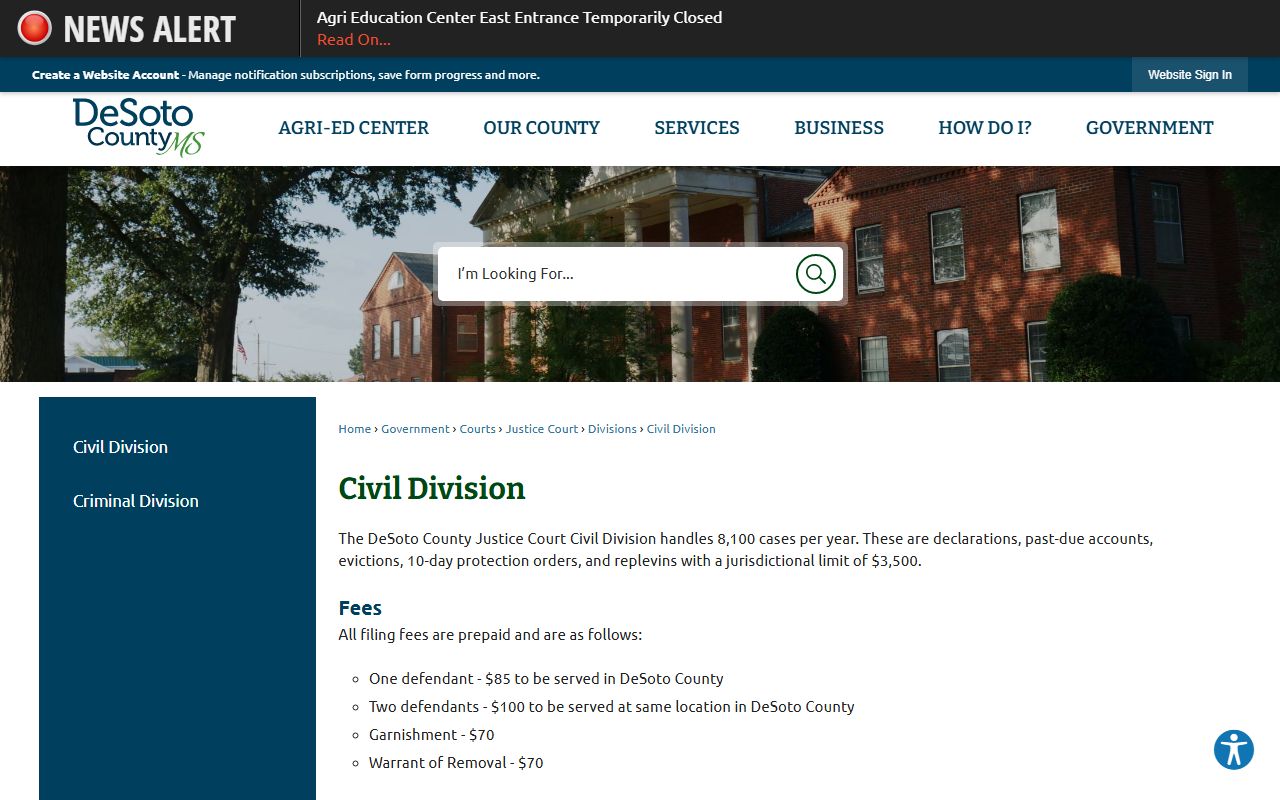
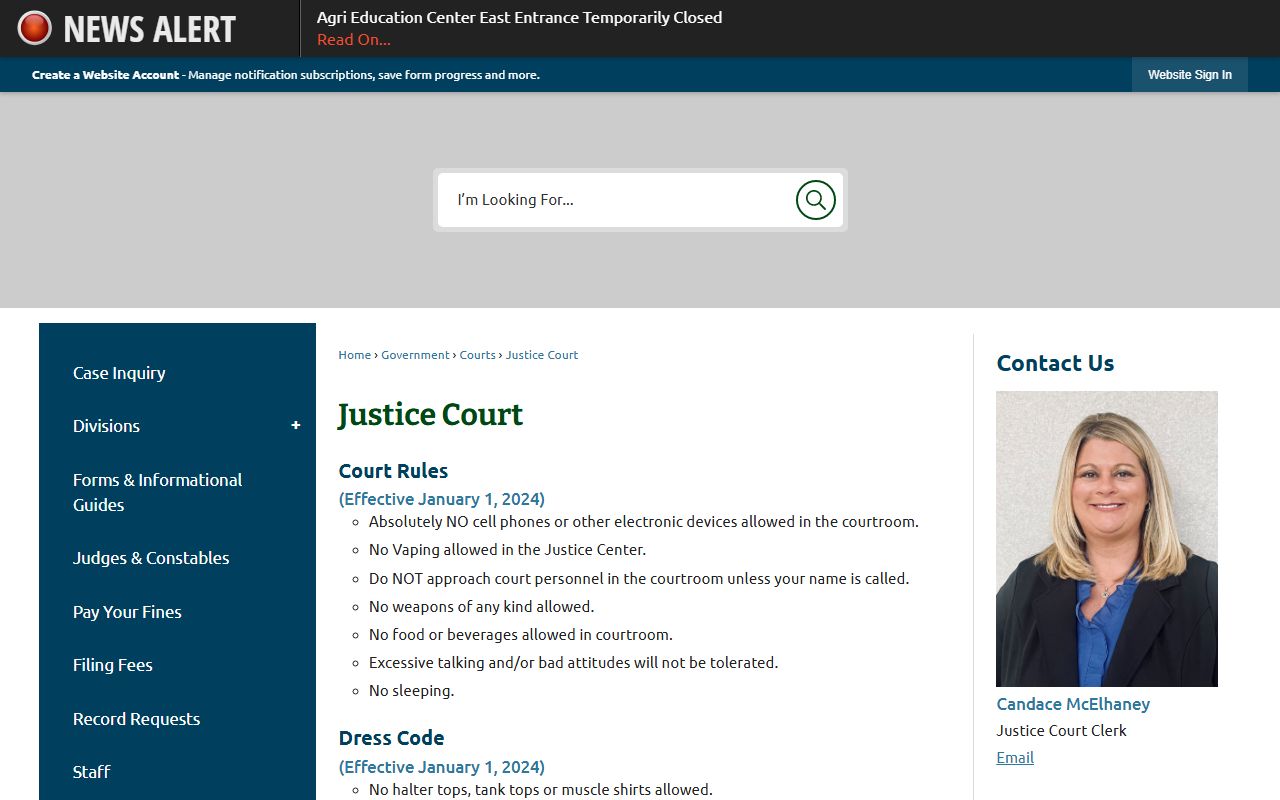
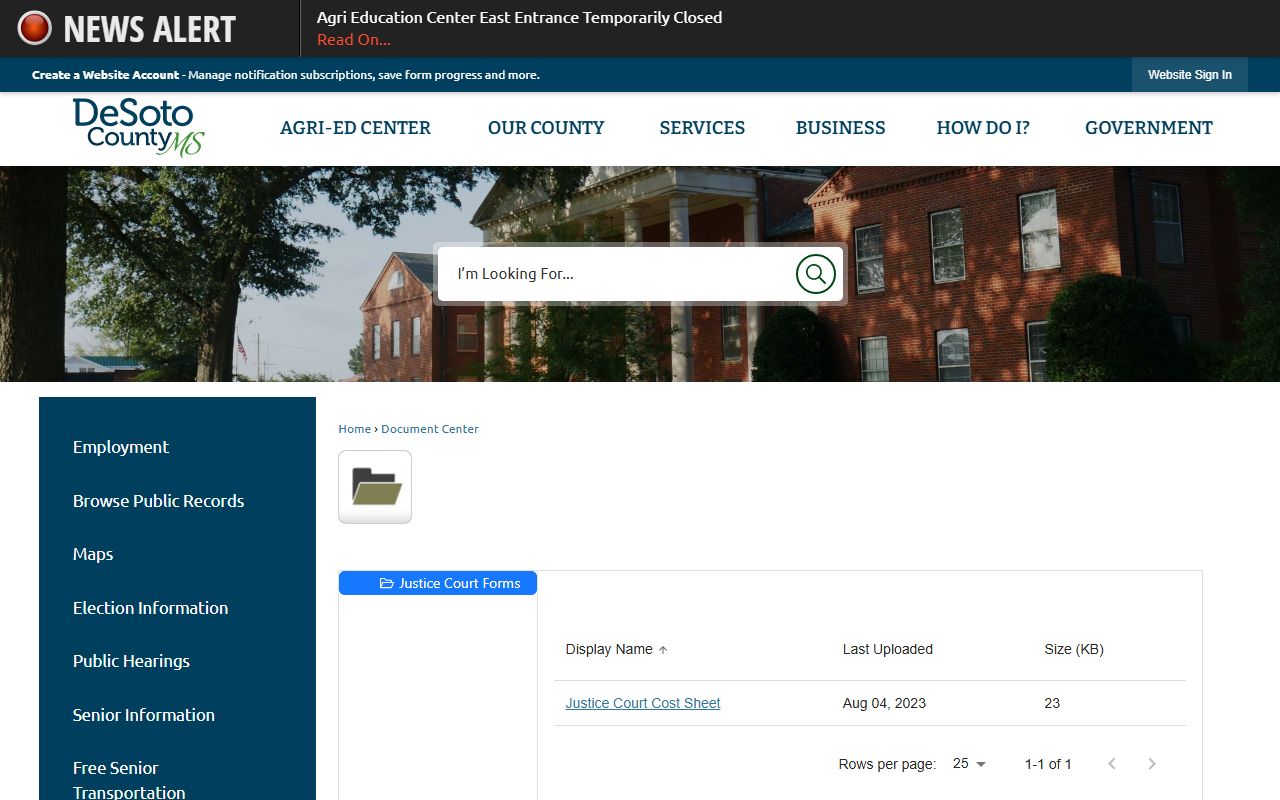
Lower courts handle the highest volume of everyday cases. Justice Court covers small claims, evictions, misdemeanors, preliminary felony proceedings, and many traffic citations outside city limits. A failure-to-appear traffic warrant or an old misdemeanor often lives on a Justice Court docket. The DeSoto County Justice Court page lists contacts for these matters.
The Justice Court page is the starting point for county-level citations and small claims.
A ticket written inside a city limit may not appear in the county Justice Court stream at all. City municipal courts keep their own dockets for ordinance, traffic, and misdemeanor cases. The main municipal courts in the county are listed below.
- Southaven Municipal Court for citations in Southaven.
- Olive Branch Municipal Court for citations in Olive Branch.
- Horn Lake Municipal Court for citations in Horn Lake.
- Hernando Municipal Court for citations in Hernando.
Note: A bench warrant or traffic case may sit in a city municipal court rather than county Justice Court, so confirm the city where the citation was issued.
Inside a DeSoto County Docket Entry
An online case docket in MEC opens with a header and then lists each event in order. The header names the court, county, case number, filing date, case type, status, and assigned judge when public. Party and attorney details follow, then the dated entries, then the hearing settings. The table below outlines the fields a typical case docket shows.
| Field | What It Shows |
|---|---|
| Case Number | Court-specific identifier used to pull the exact docket. |
| Parties | Plaintiff, petitioner, or State and the defendant or respondent, with attorney names where listed. |
| Filing Date | Date the complaint, indictment, citation, or petition opened the case. |
| Docket Entries | Each filing or event in order: complaint, motion, order, notice of hearing, continuance, judgment. |
| Hearing Date and Time | The scheduled date and time of a setting, such as arraignment, motion, or trial. |
| Courtroom | The room or division where the hearing is set, when published. |
| Judge | The judge or judicial officer assigned to the case. |
| Document Link | A link to a PDF image where public access and document availability allow. |
Not every field appears in every case. Sealed filings, juvenile entries, Social Security numbers, financial-account numbers, and minors' details may be hidden. When a document link is gated, the entry still confirms that the event happened, even if the image stays behind a login or a fee.
Hearing Dates and Continuances
Hearing entries are why most people open a docket. A setting lists the date, the time, the type of hearing, and often the courtroom and judge. As a case moves, settings change. A judge may reset a hearing, called a continuance, when a party needs more time or a conflict arises. Each reset shows on the docket, so the newest hearing entry is the one that controls. Reading the most recent setting is the only reliable way to know the current court date.
A few terms appear over and over in DeSoto County docket entries. Their plain meanings are below.
- Hearing
- A scheduled court session where a judge takes up a matter, such as a plea, a motion, or a trial setting.
- Continuance
- A postponement of a hearing or trial to a later date, which creates a new setting on the docket.
- Disposition
- The final outcome of a case or a charge, such as a plea, a verdict, a dismissal, or a judgment.
- Capias
- A warrant-like order directing officers to take a person into custody, often after a missed court date.
Note: A continuance moves a hearing but does not close a case, so an open docket with a future setting still requires the party to appear on the new date.
How to Confirm a DeSoto County Court Date
Confirming a court date takes a short, ordered process. Start with the court level, move to the right system, and verify the newest setting. The steps below work for most cases in the county.
- Identify the court. Felonies and major civil suits point to Circuit Court, family and estate matters to Chancery Court, and small claims, evictions, or county traffic to Justice Court. City citations point to the municipal court for that city.
- Open the matching system. Use MEC or PAMEC with a registered login for Circuit, County, and Chancery cases, and contact the Justice Court or city court clerk directly for lower-court matters.
- Search by exact identifier. A case number or citation number returns a cleaner result than a name-only search.
- Read the newest hearing entry. The most recent setting controls, because earlier dates may have been continued.
- Confirm with the clerk. If the record is missing, recently filed, or unclear, call the clerk for that court using the county directory to verify the date.
Dockets Versus Full Case Records
The docket and the full case record serve different jobs. The docket is a short list of events that tracks where a case stands. The full record holds the documents themselves, the motions, exhibits, signed orders, and judgments. For a quick status check or a hearing date, the docket is enough. For legal review, evidence, or a certified copy, the full record from the clerk is what counts. The comparison below sets them side by side.
| Docket | Full Case Record | |
|---|---|---|
| Format | Dated list of entries | The actual filed documents |
| Access | Online through MEC with a login, or at the counter | Counter request, sometimes a copy fee |
| Best Use | Track status and hearing dates | Legal review, evidence, certified copies |
| Detail Level | Short event descriptions | Full text, exhibits, and orders |
Many people only ever need the docket. A landlord checking an eviction setting or a defendant confirming an arraignment can stop there. A certified copy for another proceeding requires the full record, which the Circuit Clerk or Chancery Clerk provides depending on the court. A broader look at every record type is on the DeSoto County court records page.
Dockets That Are Not Public
Not every docket is open to the public. Mississippi law shields several categories, and DeSoto County courts follow those rules. Juvenile and Youth Court matters are confidential under Miss. Code Ann. Section 43-21-261, so youth case details do not show in a general docket search. Adoption records are confidential as well under Section 93-17-25.
Sealed and expunged cases drop out of ordinary public access once a court grants relief. Eligible criminal records may be expunged under Section 99-19-71. Mental-health and commitment proceedings, protective-order details, and personal identifiers can also be redacted or withheld. When a docket entry is blank, gated, or absent, a restriction may be the reason rather than a gap in the system. The clerk for that court can confirm what is releasable under Mississippi law and court rule.