
DeSoto County Arrest Records and Court Charges
A DeSoto County arrest record is the account of an arrest made by a local agency. The DeSoto County Sheriff's Department and city police make most arrests across the county. When deputies book a person into custody, they log a name, the booking date, the arresting agency, and the charges listed at the time of arrest. That booking charge is an early label. It reflects what the officer believed at the scene. It is not the final word of a court. An arrest record and the charges filed afterward live in two different places.
The booking side of an arrest sits with the jail. The county posts current detainees on its jail docket, and the booking detail also appears in the DeSoto County inmate records that track who is in custody. The charge side begins later. A prosecutor reviews the arrest and decides which court charges after arrest to file with the court clerk. From there the charges move through the case and can change. The full case file and final outcome belong to the DeSoto County criminal court records, where pleas, verdicts, and sentences are recorded.
Most arrests end with intake at the jail the sheriff runs. The DeSoto County Adult Detention Facility in Hernando handles booking and short-term custody.
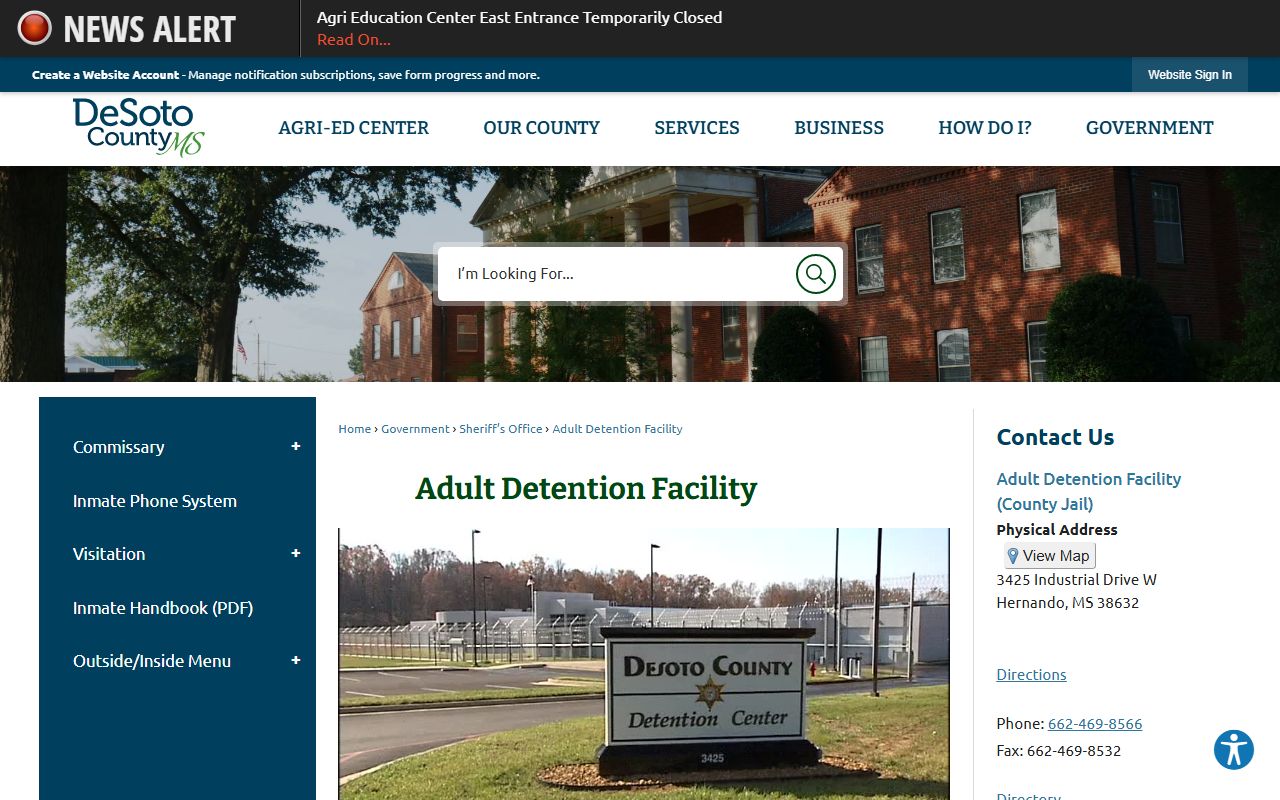
Booking detail recorded at the facility feeds the jail docket. It is still not the prosecutor's final charge, which is decided after review.
How to Find DeSoto County Arrest Records
No single portal shows both an arrest and the charges that follow it. The booking side is the fastest to find. The county posts a public jail docket that lists recent bookings and current detainees. The charge side takes more steps because filed charges appear in court case systems by court level. Felony charges generally route to Circuit Court through the Circuit Clerk. Misdemeanor and preliminary matters often start in Justice Court. A city citation points to a municipal court instead.
Recent bookings appear on the county roster first. The DeSoto County jail docket lists people booked into custody along with the charges recorded at intake.
Those docket charges are a starting point. They are not the formal charges a prosecutor files with the court.
A focused search works best when it moves from the jail to the court that holds the charge. The steps below trace that path.
- Open the county jail docket to confirm a recent booking and the arrest charges listed at intake.
- Note the full name, booking date, and arresting agency for the search ahead.
- Move to the court case system for the court level that fits the charge: Circuit, County, Justice, or municipal.
- Search by defendant name or case number, then open the case to read each filed charge, its code, level, and current status.
Some records sit outside the county entirely. People sentenced to prison move to state custody, and statewide registries hold certain charge-related records. Those channels round out a full search when the county docket comes up short.
Note: Read the arrest paperwork for the issuing court and case number, since that detail points to the right system to search.
How DeSoto County Charges Get Filed
The charge record begins after the arrest, not during it. Law enforcement makes the arrest and books the charges an officer observed. A prosecutor then reviews the file and files a formal charging document with the court. In DeSoto County, felony cases are prosecuted through the District Attorney for the 17th Circuit Court District. Three documents commonly start a criminal case. Which one applies depends on the severity of the offense and the court that hears it.
Arrests that lead to charges are made by county and city officers. The DeSoto County Sheriff's Department is the main county law enforcement agency and refers cases to the prosecutor for charging.
The arrest charge an officer books can differ from the charge the prosecutor later files. That review is where many charges change.
| Complaint | Information | Indictment | |
|---|---|---|---|
| What It Is | Sworn accusation | Prosecutor's charge | Grand jury charge |
| Filed By | Officer or prosecutor | Prosecutor | Grand jury |
| Common For | Misdemeanors | Some felonies | Serious felonies |
| Typical Court | Justice or Municipal | Circuit or County | Circuit Court |
A complaint or affidavit often supports the first appearance in DeSoto County Justice Court. A grand jury returns an indictment when it finds enough evidence to send a felony to Circuit Court. The charging document sets the counts, the statute, and the level for each charge. Many DeSoto County felony cases pass through a preliminary stage in Justice Court before the grand jury reviews them and an indictment moves the matter to Circuit Court.
DeSoto County Charge Status Explained
Charges rarely stay frozen. They change as a case moves through the court. A charge can be filed, amended, reduced, indicted, dropped, or resolved by plea. Each label tells you where a charge stands at that moment. The table below defines the status terms that show up most often in a case record.
| Status | What It Means |
|---|---|
| Filed | The prosecutor has formally charged the offense with the court. |
| Amended or Reduced | The charge was changed, often to a lesser offense. |
| Indicted | A grand jury approved a felony charge for Circuit Court. |
| Dismissed | The court dropped the charge, and it no longer moves forward. |
| Nolle Prosequi | The prosecutor chose not to pursue the charge for now. |
| Pled | The defendant entered a plea to the charge. |
| Convicted | A plea or verdict found the defendant guilty of the charge. |
A booking charge on the DeSoto County jail docket is not proof of the final filed charge or a conviction. One arrest can lead to charges that are reduced, split into separate counts, or dropped after the prosecutor reviews the file. The charge a person was booked on may never reach a courtroom in the same form. This is why a careful reader checks the court case record, not the arrest charge, to learn what a person actually faces.
Note: Charge status can change between hearings, so a record viewed today may read differently within weeks as the case moves.
Charges vs. Convictions in DeSoto County
Being charged is not the same as being convicted. A charge is an accusation. A conviction is a finding of guilt by plea or verdict. Many charges never become convictions because they are dismissed, reduced, or resolved another way. Reading a charge as proof of guilt is a common and costly mistake.
| Charge | Conviction | |
|---|---|---|
| Stage | Accusation | Verdict or plea |
| Means | A case has begun | Guilt has been decided |
| Burden of Proof | Probable cause | Beyond a reasonable doubt |
| Public Record | Yes | Yes |
Sealed vs. Expunged DeSoto County Records
Some charge records are removed from public view over time. Mississippi law lets eligible records be sealed or expunged. Sealing limits who can see a record. Expunction goes further and removes an eligible record from ordinary public access under Mississippi expunction law. The two are not the same, and neither is automatic.
| Sealed | Expunged | |
|---|---|---|
| Visibility | Hidden from public view | Removed from ordinary public access |
| Law Enforcement | Limited access | Very limited access |
| Eligibility | By charge and court order | By charge, disposition, and waiting period |
Eligibility depends on the charge, the disposition, prior record, and a waiting period set by statute. A court grants relief only when the law allows it for that category. The Circuit Clerk, Justice Court, or municipal court that handled the case can confirm whether a record qualifies.
DeSoto County Charge Codes and Levels
Each DeSoto County charge ties to a section of the Mississippi Code. The code citation names the exact offense and its level. You can look up a section through the Mississippi Code to read what an offense covers. Mississippi sorts most offenses into felonies and misdemeanors. Felonies are the more serious charges and route to Circuit Court. Misdemeanors are lower-level charges handled in Justice or municipal court. One DeSoto County arrest can produce several separate charges, each with its own code, level, and status. Reading the code and the level for every count gives a clearer picture than the short charge text shown on a jail docket.
- Charge
- A specific offense a prosecutor accuses a person of committing.
- Count
- One numbered charge within a case; a case can hold several counts.
- Statute citation
- The Mississippi Code section that defines the offense.
- Severity level
- Whether the offense is a felony or a misdemeanor.
DeSoto County Charges and Statewide Lookups
County charge records do not capture everything. Once a person is sentenced to prison, custody records move to the Mississippi Department of Corrections, searchable through the MDOC inmate search. Certain convictions also appear on a statewide public registry. These statewide tools sit apart from the county jail docket and the local court case search.
Some charges that end in conviction carry a registry requirement. The Mississippi Sex Offender Registry is a statewide public lookup for qualifying offenses.
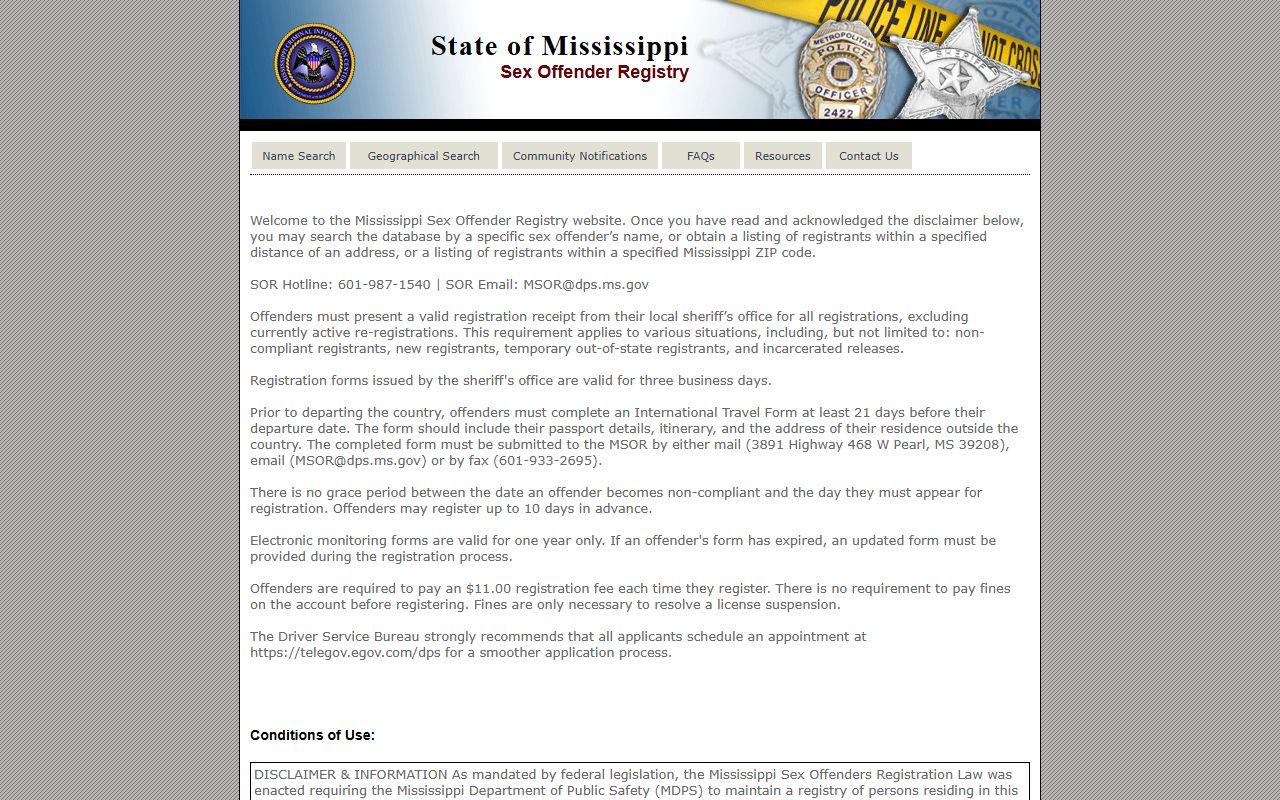
A registry listing reflects a conviction outcome, not an open arrest charge. It is one more reason to read a record for its current status before drawing a conclusion.
Background Check Considerations
A casual record search is not the same as a formal background check. Employers, landlords, and licensing bodies that use records for those decisions must follow the federal Fair Credit Reporting Act. A quick public lookup of arrest records does not meet that standard. Anyone making an eligibility decision should use a compliant screening service and verify each charge with the court of record.
Important: This is a privately operated information resource, not a consumer reporting agency under the FCRA, and its data cannot be used for employment, tenant, or credit decisions.
Restricted DeSoto County Charge Records
Not every charge record is open to the public. Youth Court and juvenile charges are confidential under Mississippi law. Sealed and expunged charges drop out of ordinary public access. Active investigation files may be withheld while a case is still open. Personal identifiers such as Social Security numbers and full dates of birth are redacted from public copies.
When a record is missing online, the clerk who handled the case is the right place to ask. County misdemeanor and traffic matters often run through DeSoto County Justice Court, while felony charges sit with the Circuit Clerk. City citations stay with the municipal court that issued them. A clerk can confirm whether a record exists, what is public, and how to request a copy.
Note: A sealed or expunged charge may still appear in older printouts, so always confirm current status with the court that handled the case.